 AI
AI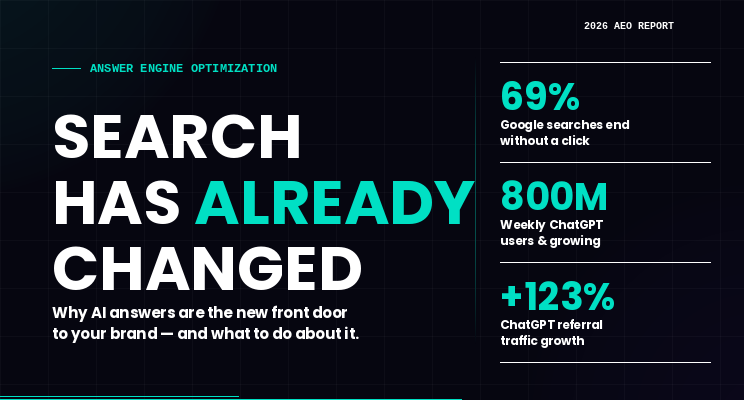
Here is something that should stop you mid-scroll. Right now, a prospective investor is typing something like "best junior gold mining companies to watch" or "what is the outlook for uranium stocks" into ChatGPT. They are not going to Google. They are not clicking through a list of links. They are getting a synthesized answer in about 10 seconds, forming an opinion about which companies deserve their attention, and moving on.
If your company or your client is not cited in that answer, they do not exist in that conversation.
That is the stakes-level framing for Answer Engine Optimization, or AEO. And I want to make something clear before we go further: this is not an SEO upgrade. This is a fundamentally different channel, and most marketing teams are not treating it that way.
What AEO Actually Does (and What It Does Not Do)
Traditional SEO gets you ranked. AEO gets you cited. Those sound similar. They are not.
SEO puts your content in a list where a human decides to click. AEO puts your content into the actual answer that AI systems deliver directly to users. The AI reads your page, extracts what it considers authoritative information, and synthesizes it into a response. Your URL might not even appear. But your data, your positioning, your company name could be the source that shapes what the user believes.
This is why the zero-click number has gotten so dramatic. According to recent data, 69% of Google searches in 2025 ended without a single click. Not because people lost interest. Because they got their answer before they needed to go anywhere.
AEO is the practice of structuring your content so that when AI systems go looking for the best answer to a question in your space, they find yours first, trust it, and use it.
Why This Hits Differently for Publishers and IR-Adjacent Brands
I work with a lot of investor relations publishers, financial newsletter brands, and resource companies who are trying to reach retail investors. And this shift in search behavior is happening right in their audience's lap.
Retail investors are not passive. They research. They compare. They ask follow-up questions. And increasingly, they are doing all of that inside AI tools, not inside Google.
According to Forrester, 89% of B2B buyers have adopted generative AI as a central source for self-directed research throughout their entire buying process. The investor audience is not far behind, and in some cases is ahead of that curve.
If a junior mining company has a compelling story about why copper demand makes them a buy, but that story lives only in compliance-scrubbed press releases and un-optimized landing pages, the AI is not going to find it and surface it. It is going to find whoever structured their content better. That is a real competitive gap. And it is widening fast.
The Direct Response Angle Nobody Is Talking About
Here is the framing that changed how I think about this. AEO is not an SEO project. It is a direct response channel.
In direct response, you do not wait for someone to stumble across your ad. You put the right message in front of the right intent at the right moment. AEO does the same thing, except the "ad" is your content, the "placement" is an AI answer, and the "moment" is when a prospect is actively asking questions about your category.
Better yet, it runs 24/7 without ad spend, does not get auto-rejected by Meta for financial services misclassification (yes, that is a real thing happening to a lot of us right now), and does not decay the way a paid campaign does when you stop feeding it budget.
The compounding effect is also real. Brands that establish authority inside AI training data and citation patterns now are building leads on other brands that wait. Once an AI system learns to trust your content as a reliable source, it keeps pulling from it. That is the kind of compounding advantage that paid media cannot create.
What AEO Actually Requires
The good news: if you are already producing solid long-form content, you are not starting from zero. AEO is largely about restructuring and signaling, not rebuilding. The four things that move the needle most:
- Structured, extractable content. AI cannot cite what it cannot parse. Wall-of-text content, even brilliant wall-of-text content, loses to clearly formatted pages with headers, concise direct answers, and logical flow. Think: answer first, context second.
- Schema markup. This is the technical layer that tells AI systems what your content is, who produced it, what entity it is about, and why it should be trusted. FAQ schema, Article schema, Organization schema. It is not glamorous, but it is the language AI reads.
- Trust signals. Author credentials, original data, cited sources, consistent entity presence across the web. AI systems are not just reading your page. They are triangulating your authority from dozens of signals. A brand that shows up consistently and credibly across multiple contexts gets cited. A brand that only exists on its own website does not.
- Content freshness. Brands leading in AEO right now are updating key pages quarterly at minimum. Stale content gets deprioritized. This is especially important in fast-moving spaces like mining, biotech, and financial markets.
The Window Is Open, But It Is Not Wide Open Forever
Every major search behavior shift has had a first-mover window. The brands that built SEO authority early in the 2000s still benefit from that foundation today. The brands that moved fast on content marketing in 2012 are still outranking competitors who were slower.
AEO is in that window right now. Category leaders are establishing dominance in AI search results across major industries. The companies cited consistently by ChatGPT, Perplexity, and Google AI Overviews today are doing so in part because they moved while their competitors were still debating whether this was worth their time.
Delayed adoption means more expensive catch-up later. And in the investor space especially, share of voice in AI answers is going to become a hard asset.
So What Do You Do With This?
Start by testing what AI currently says about your brand or your clients. Open ChatGPT or Perplexity and ask questions your target investor would ask. See who gets cited. See what language gets used. That audit alone will tell you more about your current AEO standing than any SEO report.
Then look at your existing content and ask whether it is structured to be extracted. Not just read. Extracted. That single lens shift changes everything about how you write and format content going forward.
AEO is not the future of search. It is the present state of how your most important prospects are already researching. The question is whether your content is ready to meet them there.
Want to know exactly where your page stands? I will run the audit myself.
I spent a significant amount of time researching the standards, scoring systems, and ranking signals that determine how AI platforms evaluate and cite content. Every factor that influences whether a page gets extracted, quoted, or ignored. Then I built a custom AI system that applies all of it: feed it any URL, and it runs a structured audit against those signals, scores the page across each dimension of AI readiness, and produces a prioritized action plan with specific, executable changes ranked by impact. Not vague recommendations. Actual tasks, in order, that move the needle.
If you read this and felt the urgency of this shift, I want to make it easy to take the first step. Send me your URL and I will personally run it through the system and send you the full scored report. No cost. No pitch. Just a clear picture of where you stand and a path forward.
Send My URL for a Free Snapshot